Meta-analytic decoding
Meta-analytic decoding relates a brain map to terms or topics extracted from a large neuroimaging literature. CALMaR can use this as an exploratory bridge between spatial results and published functional associations.
Forward and reverse questions
- Forward inference: where does the literature report activity for a selected task or term?
- Reverse decoding: which terms are statistically associated with a supplied brain map?
These are not interchangeable. Reverse decoding is especially vulnerable to overinterpretation when base rates, study selection, and correlated terms are ignored.
What the output represents
A decoding score summarises an association between the supplied map and a literature-derived term map under a particular method and database version.
It does not establish that the patient:
- Performed the task represented by the term
- Has an impairment named by the term
- Uses the same functional organisation as the aggregated studies
- Should receive a therapy associated with that term
CALMaR wording
Technical caution is only part of responsible wording. Reports should also avoid ableism: language that treats disability or communication difference as evidence of lesser competence, agency, value, or quality of life. A statistical term returned by a decoder must not become a label for the person.
Respectful language should still be simple and direct. Long, heavily qualified sentences can make important information inaccessible—particularly in a project concerned with acquired communication disorders. Directness and respect are not opposites.
Useful writing rules include:
- Put one main claim in each sentence.
- State what was measured before explaining what it might mean.
- Separate the result, uncertainty, and possible clinical relevance.
- Use person, participant, or the person's preferred language rather than reducing someone to a lesion or diagnosis.
- Do not infer intelligence, decision-making capacity, motivation, or quality of life from a communication impairment.
- Prefer concrete descriptions of activity and participation over broad deficit labels.
- Preserve technically necessary terms, but define them the first time they appear.
Prefer language such as:
The affected map overlaps literature-derived spatial associations for these terms.
Or, when reporting to a broader audience:
This brain map overlaps areas that research studies have associated with these functions. It does not show which abilities this person can or cannot use.
Avoid language such as:
The scan predicts that the patient has these deficits.
Implementation information to retain
- Source database and version
- Included study domain
- Decoding algorithm
- Input map and space
- Thresholding and masking
- Score definition
- Multiple-comparison or ranking approach
- Whether the output is exploratory
NiMARE
NiMARE—the Neuroimaging Meta-Analysis Research Environment—is an open-source Python library for coordinate-based and image-based meta-analysis, functional decoding, correction, and diagnostics. It is a software library rather than a single analysis: the result depends on the dataset, estimator, decoder, correction method, and parameters selected.
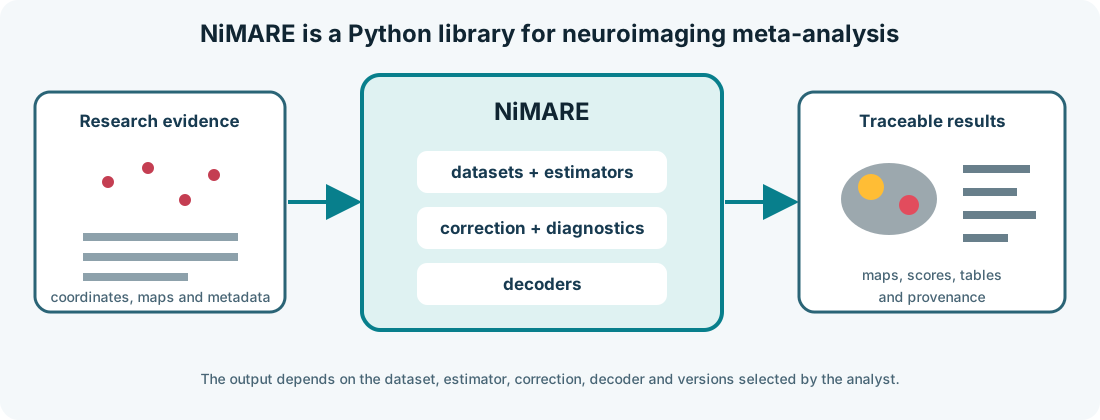
CALMaR contributors should understand the selected decoder and its assumptions rather than treating a returned term list as self-validating.